After the Event: Public Service Reform in Practice
On 27 May 2026, the New South Institute (NSI), in partnership with the Konrad-Adenauer-Stiftung (KAS) and the University of Pretoria (UP), hosted a seminar on the practical implications of public service reform in South Africa.
The seminar focused on the Public Service Amendment Act and its implications for the relationship between political and administrative authority. The legislation introduces a clearer separation between political office and administrative management, including by removing operational and human resource powers from political office-bearers. For NSI, this marks an important institutional shift in South Africa’s democratic trajectory, described as the country’s “third transition” after the democratic and constitutional transitions of 1994 and 1996.
The discussion brought together academics, practitioners, and civil servants to examine what this transition may require in practice. Rather than approaching reform only as a legal or policy question, the seminar considered the institutional conditions that will determine whether professionalisation can be implemented effectively.
A central contribution came from NSI Director Ivor Chipkin, who presented recent analysis of PERSAL data. The modelling points to a significant demographic challenge in the public service, with roughly 76% of public servants over the age of 50. This raises concerns about institutional memory, continuity, and succession planning. At the same time, the scale of impending turnover creates an opportunity to recruit and develop a new generation of public servants, provided that the state is able to build credible talent pipelines and strengthen its capacity to manage personnel strategically.
The panel discussion explored several constraints that may shape this process. Prof. Albert Wöcke of the Gordon Institute of Business Science addressed the absence of effective talent management in the public sector. He argued that compliance-driven systems often limit the ability of departments to plan for succession and allocate skills appropriately. Drawing on the health sector, he noted the decline in professional nurses alongside a substantial increase in administrative personnel, pointing to broader weaknesses in workforce planning.
Prof. Gerda van Dijk, Director of the School of Public Management and Administration at UP, cautioned that reform cannot assume the existence of institutional capacity, particularly at local government level. She emphasised that professionalisation requires enforceable standards and workable implementation mechanisms, rather than remaining a general ethical aspiration.
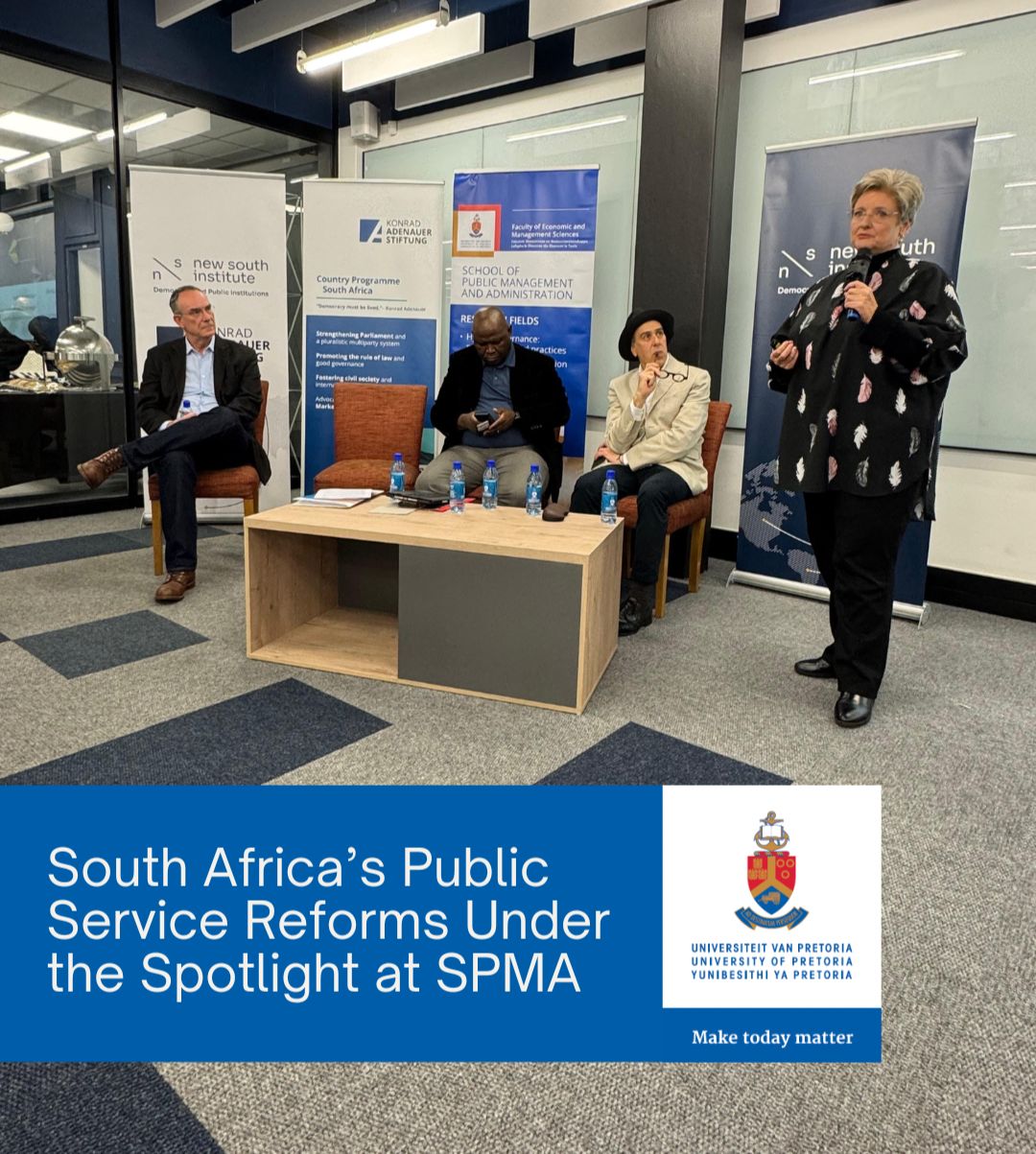
Prof. Somadoda Fikeni, Chairperson of the Public Service Commission, situated the challenge within the political economy of the state. He described fragmentation in the public service as “dysfunction by design”, arguing that inefficient arrangements can obscure patronage and weaken accountability. He called for more anticipatory forms of governance, better use of personnel data, and stronger links between academic analysis and administrative practice.
The seminar underlined that public service reform will depend not only on legislative change, but on the state’s ability to address demographic pressures, rebuild talent systems, and strengthen institutional capability. The full discussion and speaker presentations are available below.
Video recording: Watch the full seminar here
Presentation slides: South Africa’s Third Transition – Ivor Chipkin
Presentation slides: Talent Management in the SA Public Service – Prof. Albert Wöcke
Presentation slides: Public Leadership and Institutional Reform – Prof. Gerda van Dijk


